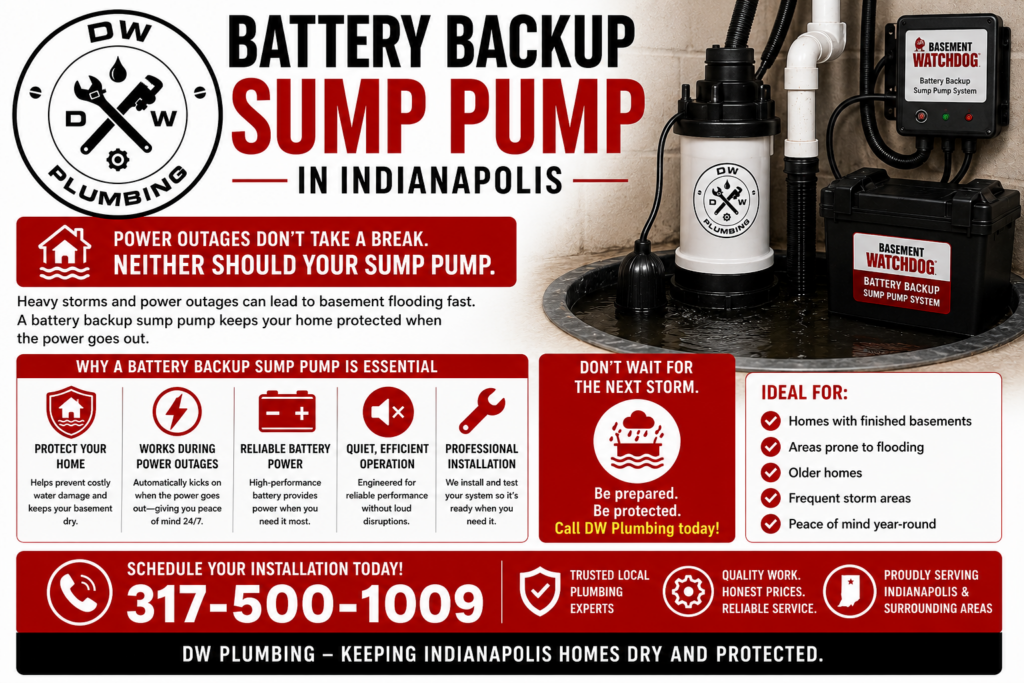
DW Plumbing recommends battery backup sump pumps for most Indianapolis homes with finished basements, because Marion County’s worst storms regularly knock out power during the exact moments primary sump pumps are needed most. A battery backup system uses a deep-cycle marine battery to power a secondary pump when AC power fails, keeping the basement dry through extended outages and saving thousands in flood damage costs.
For homeowners across Indianapolis, Beech Grove, Greenwood, Fishers, and surrounding cities, the question is rarely whether a battery backup is worth the money. It is when to install one before the next big storm.
Why Battery Backups Matter in Indianapolis
Indianapolis sits in a region where severe thunderstorms, ice storms, and the occasional derecho regularly knock out residential power. According to the Federal Emergency Management Agency, basement flooding is one of the most common and expensive forms of property damage in the United States, and most homeowner insurance policies do not cover groundwater flooding through a failed sump pump.
The problem is simple. The storms that cause the highest water table conditions and the heaviest basement inflow are the same storms most likely to take out the AC power that runs your primary pump. Without a backup, the pit fills, the basement floods, and the bill arrives a few days later.
A battery backup sump pump runs independently of your home’s electrical system. When the power fails or the primary pump fails for any other reason, the backup automatically activates and discharges water until power returns or the battery is depleted.
How a Battery Backup Sump Pump Works
A battery backup system has four main components:
- A secondary submersible pump installed in the same pit as the primary, mounted slightly higher so it activates only when the primary fails or cannot keep up
- A deep-cycle marine battery, similar to what powers a boat trolling motor, sized to run the backup pump for hours of continuous use
- A controller box that monitors AC power, battery charge level, and pump activation, often with an audible alarm
- A separate float switch for the backup pump that triggers when water rises above the primary float
When the primary pump runs normally, the backup sits dormant and the controller keeps the battery topped up. When the primary fails because of a power outage, stuck float, burned out motor, or a clogged sump pump discharge line, water rises to the backup float and the secondary pump kicks on automatically.
When DW Plumbing Recommends Battery Backup
DW Plumbing recommends battery backup installation for any Indianapolis home that meets one or more of the following criteria:
- A finished basement of any size, since flooding causes catastrophic damage to drywall, flooring, furniture, and electronics
- A history of power outages during severe storms
- A primary sump pump older than 5 years
- A home in an Indianapolis neighborhood with a high water table, including much of the east side, areas near the White River, and parts of Castleton and Lawrence
- Anyone planning extended travel during spring rain season from March through June
- Homes with sump pumps that run frequently, since high-cycle pumps wear out faster and fail without warning
If you are not sure whether your existing sump pump is keeping up, our guide on how to know if a sump pump is working or starting to fail walks through a simple homeowner test you can do in 5 minutes.
Battery Backup vs Water-Powered Backup
Two backup technologies exist for sump pumps. Most Indianapolis installations use battery backup, but water-powered units are sometimes a better fit.
Battery backup pros: Works in any home with municipal or well water. Runs without AC power. Easy to retrofit to existing pumps. Standard residential install.
Battery backup cons: Battery lifespan limited to several hours of continuous use. Battery itself needs replacement every 3 to 5 years. Requires occasional testing.
Water-powered backup pros: Unlimited runtime as long as municipal water pressure holds. No battery to replace.
Water-powered backup cons: Requires municipal water and does not work on well water. Uses 1 to 2 gallons of city water for every gallon pumped out, which can be expensive during extended events. Some Indianapolis suburbs restrict water-powered backup pumps.
For most Indianapolis homes connected to Citizens Energy Group municipal water, DW Plumbing typically recommends battery backup as the better long-term value. For homes on well water, battery backup is the only option.
How Long Will the Battery Last?
A properly sized deep-cycle marine battery in a battery backup sump pump system will typically run a residential backup pump for 5 to 12 hours of continuous use, or significantly longer with intermittent cycling. This is more than enough to cover the vast majority of Indianapolis power outages, which usually last under 6 hours.
For homeowners worried about extended outages, DW Plumbing offers dual-battery systems that double the runtime. A generator interlock at the main electrical panel is another option for whole-home backup that keeps the primary pump running indefinitely.
Battery Backup Installation Cost in Indianapolis
Battery backup installation cost depends on the pump model, battery capacity, whether the existing pit can accommodate a second pump, and whether any plumbing modifications are needed for the dual discharge line. DW Plumbing provides written estimates after a free in-home assessment.
For an accurate quote on your specific home, call (317) 500-1009 or visit our contact page.
Maintenance and Testing
DW Plumbing recommends testing your battery backup sump pump every 3 months:
- Unplug the primary pump’s power cord
- Pour a bucket of water into the pit to raise the float
- Verify the backup activates and discharges the water
- Check the controller for any alarm or low-battery warnings
- Plug the primary back in
Replace the battery every 3 to 5 years, or sooner if the controller indicates degraded capacity. Most batteries fail without warning, so proactive replacement is cheaper than emergency replacement during an outage.
DW Plumbing offers annual sump pump and backup system inspections for Indianapolis homeowners who prefer to leave maintenance to a licensed plumber. Learn more on our sump pump service page.
Frequently Asked Questions
How long does the battery last in a backup sump pump?
A standard deep-cycle marine battery in a residential backup sump pump system runs for 5 to 12 hours of continuous use, or considerably longer if the pump cycles intermittently. DW Plumbing recommends dual-battery systems for Indianapolis homeowners who experience frequent extended outages.
Can a battery backup sump pump replace a primary pump?
No. Battery backup sump pumps are designed for short-term emergency use only. The pump motors are smaller, the duty cycle is limited, and continuous use will quickly drain the battery and burn out the pump. DW Plumbing always installs backup pumps alongside, not in place of, a working primary pump.
How often should the backup battery be replaced?
DW Plumbing recommends replacing the backup battery every 3 to 5 years in Indianapolis homes. Batteries lose capacity gradually and often fail without warning. Most modern battery backup controllers include a low-battery alarm that signals when replacement is due.
Does DW Plumbing install water-powered backups?
Yes. DW Plumbing installs both battery backup and water-powered backup sump pumps in Indianapolis. Water-powered units are best suited for homes connected to municipal water with strong pressure. Battery backup is the only option for homes on well water.
Will my battery backup run during an extended power outage?
A standard battery backup sump pump in an Indianapolis home will run for several hours to half a day during a power outage, depending on how often the pump cycles. For outages longer than that, DW Plumbing offers dual-battery systems or recommends a portable generator with a transfer switch that can keep the primary pump running indefinitely.
How much does battery backup installation cost in Indianapolis?
DW Plumbing prices battery backup sump pump installation in Indianapolis based on the pump and battery selected, the existing pit configuration, and whether the discharge line needs modification to accommodate a second pump. Call (317) 500-1009 for a free in-home assessment and written estimate.