DW Plumbing gets the tank vs tankless question every week from Indianapolis homeowners facing a water heater replacement. The honest answer is that neither option is universally better. The right choice depends on your home’s hot water demand, your fuel source, how long you plan to stay in the home, and your tolerance for higher upfront cost in exchange for lower monthly bills. Over a 10-year ownership period, the math can favor either option depending on the home.
This guide walks through every cost category Indianapolis homeowners should compare before deciding, including a few hidden costs most online articles ignore.
The Quick Answer
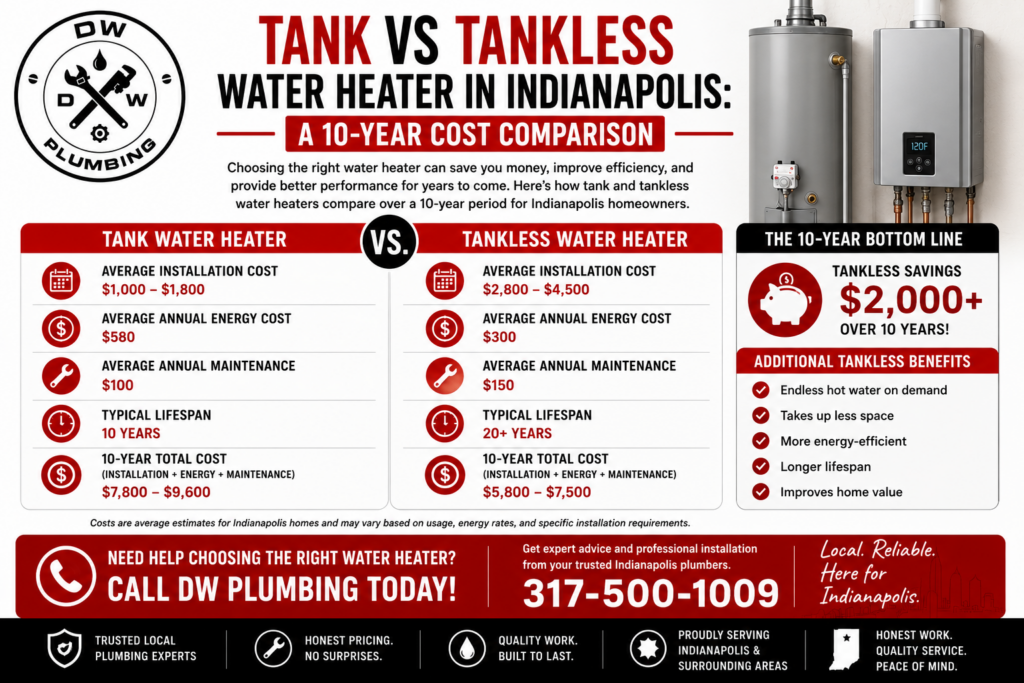
For most Indianapolis homes that plan to stay in place for 10 years or more, have a family of three or more, and have natural gas service, a tankless water heater wins the 10-year cost comparison despite costing significantly more upfront. For Indianapolis homeowners planning to sell within 5 years, smaller households, or homes without easy access to gas venting, a high-efficiency tank water heater is usually the better financial decision.
The full breakdown below explains why.
Upfront Cost Comparison
Tank water heater installation in Indianapolis is the more affordable option upfront. A standard 40 or 50 gallon natural gas or electric tank is the most common residential install, and most replacements use the existing connections, venting, and location. Installation is typically completed in a few hours.
Tankless water heater installation in Indianapolis costs significantly more upfront because of the unit price difference and the labor involved. Most tankless installations require new gas line sizing (a tankless unit demands more BTU than a tank), new venting (Category III stainless steel or PVC depending on the unit), a 120V electrical outlet near the unit, and often a relocation from the basement to a wall-mounted position. For homes converting from tank to tankless for the first time, expect installation to take a full day.
The upfront cost difference can be substantial. The question is whether monthly operating savings recover that gap within your ownership window.
Energy Cost Comparison
This is where tankless starts to make its money back. A tank water heater keeps 40 to 50 gallons of water hot 24 hours a day, even when no one is home and no one is using hot water. This is called standby heat loss, and the U.S. Department of Energy estimates that for typical households, water heating accounts for around 20 percent of total home energy use.
Tankless water heaters avoid standby heat loss because they heat water only when it is needed. The U.S. Department of Energy notes that demand water heaters can be 24 to 34 percent more energy efficient than conventional storage models in homes using 41 gallons or less of hot water per day. Actual savings depend on household demand, fuel type, and equipment efficiency.
For an Indianapolis family of four with average hot water use, the monthly energy savings from tankless add up year after year. Over a 10-year period, this is where most of the tankless cost-recovery comes from.
Lifespan Comparison
A standard tank water heater in Indianapolis typically lasts 8 to 12 years. Hard water from Citizens Energy Group accelerates sediment buildup at the bottom of the tank, which is why our guide on sediment in hot water tanks recommends annual flushing. Indianapolis water hardness is a factor in tank longevity, covered in our post on water hardness in Indianapolis homes.
A tankless water heater in Indianapolis typically lasts 15 to 20 years with proper maintenance, often outliving two tank units. This longevity advantage is significant when calculating 10 or 20 year ownership costs. If you keep a tank water heater for 16 years, you have installed two units. If you keep a tankless for 16 years, you have installed one.
For homeowners planning to stay in their Indianapolis home long-term, the lifespan advantage compounds the energy savings into a clear tankless win on total cost of ownership.
Maintenance Cost Comparison
Tank water heater maintenance is straightforward and infrequent. DW Plumbing recommends annual flushing to remove sediment, anode rod inspection every 3 to 5 years (replacement every 5 to 7 years), and a periodic check of the temperature and pressure relief valve. Total annual maintenance cost is low. Our guide on extending the life of your water heater with routine maintenance covers the full schedule.
Tankless water heater maintenance requires annual descaling, which is more involved than flushing a tank. The unit needs a recirculating pump connected to a vinegar or commercial descaler solution that runs through the heat exchanger for about an hour. Indianapolis hard water makes annual descaling non-negotiable. Skipping descaling will void most manufacturer warranties and shorten the unit’s life.
DW Plumbing offers annual maintenance plans for both tank and tankless installations in Indianapolis. The labor cost difference between flushing a tank and descaling a tankless is modest. Over 10 years, both maintenance costs are a small fraction of total ownership cost.
Recovery Rate vs Endless Hot Water
This is the comfort factor that often tips Indianapolis homeowners toward tankless even when the financial math is close.
A 50-gallon tank water heater holds 50 gallons of hot water and then needs 30 to 60 minutes to reheat after that water is used. A family of four taking back-to-back showers can empty the tank and the last person ends up in lukewarm water. The fix is a bigger tank, which costs more, takes up more space, and increases standby heat loss.
A tankless water heater delivers hot water continuously as long as the demand does not exceed the unit’s flow rate (measured in gallons per minute). A properly sized tankless can run a shower, a dishwasher, and a load of laundry simultaneously without running out. For Indianapolis families with multiple morning showers in sequence, this is the single most cited reason for choosing tankless.
For undersized tankless units, the limitation is flow rate rather than tank capacity. If three showers run at once and the unit only outputs enough hot water for two, the temperature drops. Proper sizing during installation is the difference between a tankless that delights and a tankless that disappoints.
Indianapolis-Specific Considerations
A few factors affect the tank vs tankless decision for Indianapolis homes specifically:
Natural gas availability. Tankless water heaters perform best on natural gas. Indianapolis has widespread natural gas service through CenterPoint Energy. For homes without gas service, propane and electric tankless options exist, but the cost calculation shifts.
Older home venting constraints. Indianapolis homes built before 1980 often have brick chimneys originally vented for both furnace and water heater. Converting to tankless usually requires new direct venting (stainless steel or PVC through a sidewall), which adds installation complexity and cost.
Hard water. Indianapolis water hardness ranges from moderate to hard depending on the neighborhood. Hard water shortens both tank and tankless lifespans without proper maintenance, but tankless units are more sensitive. A whole-home water softener becomes a strong recommendation for tankless owners.
Cold incoming water in winter. Indianapolis groundwater enters homes at temperatures around 50 degrees in summer but can drop into the 40s during a cold winter. Tankless units have to work harder to heat colder incoming water, which means a unit sized correctly for summer demand may underperform in January. Slightly oversizing the tankless for winter is the standard fix.
For Indianapolis homeowners showing the warning signs that a water heater needs replacing or experiencing a popping water heater, now is the right moment to weigh tank versus tankless rather than reflexively replacing with the same type.
When Tank Is the Right Choice
DW Plumbing recommends a tank water heater for Indianapolis homeowners when:
- Planning to sell the home within 5 years (upfront cost recovery requires longer ownership)
- The home has a 1 or 2 person household with modest hot water demand
- The existing setup is electric and switching to gas is impractical
- Budget for installation is the primary constraint
- The home does not have natural gas service
A modern high-efficiency tank, including hybrid heat pump water heaters for homes with adequate space and ventilation, can deliver respectable efficiency at a fraction of the tankless upfront cost.
When Tankless Is the Right Choice
DW Plumbing recommends a tankless water heater for Indianapolis homeowners when:
- Planning to stay in the home for 10 years or more
- The household is 3 or more people with high hot water demand
- The home has natural gas service and acceptable venting routes
- Hot water frequently runs out with the current tank
- The mechanical room space is at a premium and a wall-mounted unit would free up usable space
- Long-term operating cost matters more than upfront cost
For a definitive recommendation based on your specific Indianapolis home, hot water usage, and budget, call DW Plumbing for a free assessment.
Get a Personalized Recommendation
DW Plumbing installs both tank and tankless water heaters across Indianapolis, including high-efficiency condensing tankless units, heat pump water heaters, and standard 40 and 50 gallon natural gas and electric tanks. Every installation includes proper sizing for your specific household demand, code-compliant venting, and a warranty on both parts and labor.
For a free in-home assessment and side-by-side written quote on tank versus tankless for your Indianapolis home, call (317) 500-1009 or visit our water heater service page.
Frequently Asked Questions
Is a tankless water heater worth it in Indianapolis?
A tankless water heater is worth it for most Indianapolis homeowners who plan to stay in the home for 10 years or more, have a family of 3 or more, and have natural gas service. The 10-year energy savings combined with the longer unit lifespan typically recover the higher upfront cost. For shorter ownership windows or smaller households, a high-efficiency tank is usually the better value.
How long does a tankless water heater last in Indianapolis?
A properly maintained tankless water heater in an Indianapolis home typically lasts 15 to 20 years, compared to 8 to 12 years for a standard tank water heater. Annual descaling is critical for tankless longevity given Indianapolis hard water. DW Plumbing offers annual maintenance plans that protect the manufacturer warranty and extend service life.
Why does a tankless water heater cost more to install in Indianapolis?
Tankless water heater installation costs more in Indianapolis because the unit itself is more expensive, the existing gas line often needs upsizing to meet the higher BTU demand, new direct venting must be installed (older homes vented through chimneys cannot reuse the same flue), and a 120V electrical outlet must be added near the unit. Total install time is typically a full day versus a few hours for a tank replacement.
Will a tankless water heater save money on my Indianapolis utility bill?
Yes, a tankless water heater will reduce the water heating portion of an Indianapolis homeowner’s utility bill by eliminating standby heat loss. According to the U.S. Department of Energy, tankless units are 24 to 34 percent more efficient than tanks for low-use homes and 8 to 14 percent more efficient for high-use homes. Actual monthly savings depend on the home’s hot water consumption and the difference between the old unit’s efficiency and the new tankless rating.
Do tankless water heaters work well with Indianapolis hard water?
Tankless water heaters work in Indianapolis hard water conditions, but they require annual descaling to remove the mineral buildup that accumulates inside the heat exchanger. Indianapolis homeowners with tankless units typically benefit from a whole-home water softener, which extends the time between descaling services and protects the warranty. DW Plumbing can install or service both the tankless and the softener.
Can DW Plumbing replace my tank water heater with tankless in Indianapolis?
Yes. DW Plumbing converts tank water heaters to tankless across Indianapolis, including the necessary gas line upsizing, direct venting installation, electrical work, and sizing for the specific home’s hot water demand. A free in-home assessment determines whether the existing utilities can support tankless and what modifications are required. Call (317) 500-1009 to schedule.