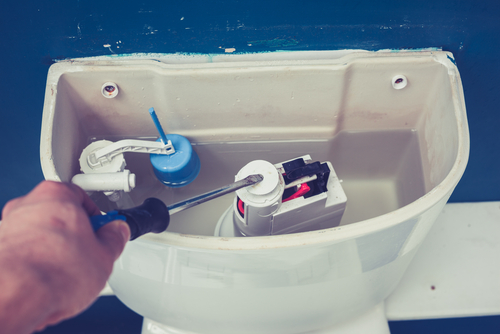
That constant trickle of water in the back of your toilet is not just background noise – it is money draining out of your house every minute it continues. A running toilet can waste 200 gallons of water per day or more, and in Indianapolis, where water and sewer rates have steadily increased over the last several years, that adds up to real money on your monthly bill.
The good news is that the cause is usually one of a handful of common components. The bad news is that if you let it go, a running toilet can escalate into water damage, subfloor rot, and a much bigger repair bill.
The Flapper Is the Most Common Culprit
The flapper is the rubber seal at the bottom of the tank that lifts when you flush and drops back down to stop water from flowing into the bowl. Over time, the rubber warps, cracks, or accumulates mineral deposits – especially in Indianapolis where our hard water accelerates wear on rubber and plastic components.
When the flapper does not seal properly, water leaks continuously from the tank into the bowl. The fill valve detects the dropping water level and keeps refilling the tank, creating that constant running sound. A simple way to test this: put a few drops of food coloring in the tank and wait 15 minutes without flushing. If the color appears in the bowl, the flapper is leaking.
The Fill Valve Is Stuck or Failing
The fill valve controls how much water enters the tank after each flush. When it malfunctions, it may run nonstop, overfill the tank and send water down the overflow tube, or cycle on and off randomly without a flush – sometimes called “phantom flushing.”
Fill valves are replaceable, but the right valve needs to match your toilet model and your water pressure. If you are unsure, a licensed plumber can diagnose and swap it quickly.
The Float Is Set Too High
The float mechanism – either a ball float on an arm or an integrated float on the fill valve – tells the fill valve when to shut off. If the float is set too high, the water level rises above the overflow tube and drains continuously into the bowl. Adjusting the float downward by about half an inch below the overflow tube opening usually resolves this.
The Overflow Tube Is Cracked
Less common but worth checking: if the overflow tube inside the tank is cracked, water leaks directly into the bowl regardless of the float setting. This requires replacing the flush valve assembly, which is a more involved repair.
When a Running Toilet Signals a Bigger Problem
A running toilet is usually a tank component issue. But if you also notice water on the floor around the base of the toilet, a toilet leak may be happening at the wax ring seal between the toilet and the floor flange. That is a different problem – and one that can damage subfloor and ceiling materials below if left unaddressed.
We covered the long-term consequences of ignoring these leaks in our post on what happens if you ignore a small toilet leak. The short version: it gets expensive fast.
Quick Fixes You Can Try Before Calling a Plumber
Check the flapper for visible damage or mineral buildup and replace it if needed – flappers are available at any hardware store for a few dollars. Adjust the float height so the water level sits about half an inch below the overflow tube. Make sure the flush handle chain has slight slack and is not holding the flapper open.
If these steps do not resolve the running, or if the toilet continues to cycle after you have replaced the flapper and adjusted the float, the fill valve or flush valve assembly needs professional attention.
When to Call a Licensed Plumber
Call a plumber if the running persists after you have tried basic fixes, if there is water around the base of the toilet, if the toilet rocks on the floor (indicating a compromised wax seal or damaged flange), or if you have an older toilet that is experiencing multiple issues simultaneously. At a certain point, replacing the entire toilet is more cost-effective than repairing individual components on a unit that is 15 or 20 years old.
DW Plumbing handles toilet repairs, replacements, and installations across Indianapolis and surrounding counties. We show up with the parts, quote you upfront, and fix it in one visit.
Call 317-500-1009 to stop the running – and stop the wasted water – today.