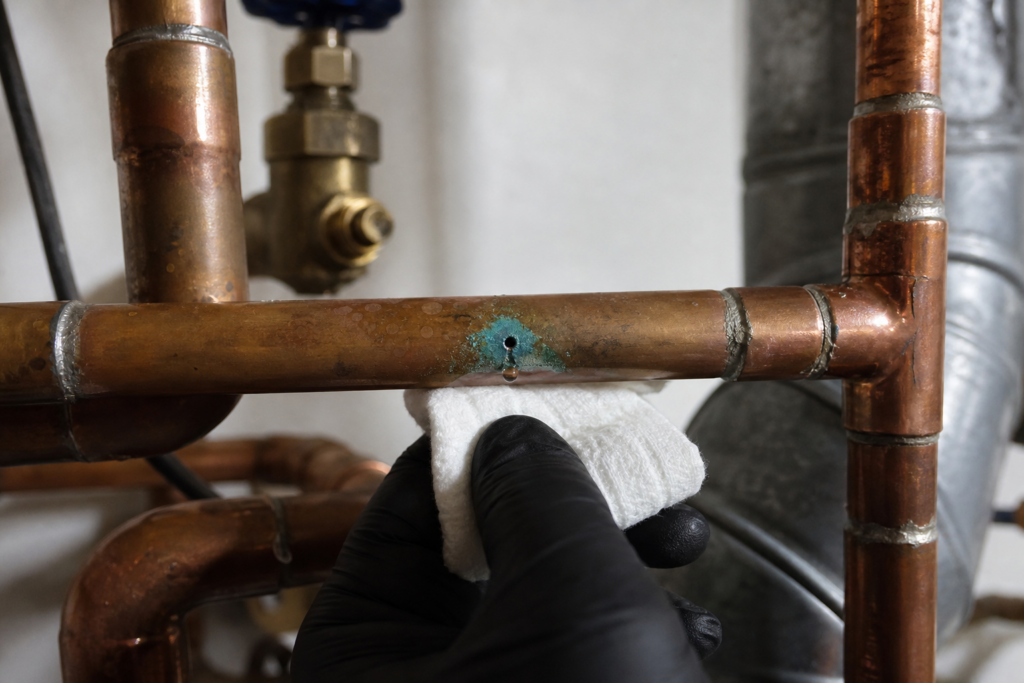
Repairing one pinhole stops that leak but does not establish the condition of nearby copper. A later leak may be another isolated defect, or several failures may reflect a condition affecting a longer run.
Recurring pinholes do not automatically mean the entire home needs new piping. A plumber should locate the failures, inspect accessible copper, review the timing, and evaluate possible contributors before recommending a localized repair, partial replacement, or whole-house repiping.
Why a Tiny Opening Can Become a Repeated Problem
A pinhole leak is a tiny perforation through a water-supply pipe. Even a bead or fine mist can damage insulation, drywall, framing, flooring, or nearby equipment before the leak becomes obvious.
A coupling or replacement section can remove the failed area, but it does not test every nearby section. If a scratch, poorly prepared joint, or unusual contact point caused the opening, the rest of the system may be sound. If the wall has thinned in several places, another weak point may leak later.
The key question is whether the leaks form a pattern and whether inspection shows similar deterioration beyond the repaired spots.
Possible Contributors to Copper Pinhole Leaks
Several conditions can contribute to copper deterioration. Their presence does not prove that any one condition caused a particular leak, and more than one factor can be involved.
Internal corrosion and water chemistry
Water chemistry can influence copper over time. pH, alkalinity, dissolved minerals, disinfectant conditions, temperature, dissolved gases, and deposits may affect the protective film inside a pipe or create localized conditions at its wall.
These possibilities require evidence. A homeowner should not conclude that Indianapolis water caused the leaks, and a visual stain is not a water-quality test. When chemistry is a reasonable concern, samples should be collected and interpreted by a qualified water-testing provider using an appropriate method. Results need to be considered alongside the piping itself.
High velocity or turbulence
Fast-moving water and turbulence near fittings, valves, turns, or restrictions may contribute to erosion-corrosion in some systems. Static pressure and flow velocity are not the same measurement; pipe diameter, demand, circulation, and damage location also affect the evaluation.
A plumber may compare static and working pressure and check whether failures occur near fittings, recirculation piping, or other sources of disturbed flow. One pressure reading does not explain a pinhole.
Installation details and flux residue
Installation conditions can affect a limited area. Excess flux inside a soldered joint, overheating, poor preparation, abrasion, incompatible contact materials, or stress at an unsupported connection may contribute to localized damage. These explanations carry more weight when leaks cluster around similar joints or one installation section.
A problem at one fitting does not establish that every copper line was installed incorrectly. Compare the surrounding pipe, support, joints, and failure locations before defining the repair scope.
Electrical grounding or unintended current
Metal piping can be part of a building’s grounding and bonding system. Improper connections or unintended current may deserve investigation. A plumber can note unusual patterns, but electrical testing and corrections belong with a qualified electrician.
Do not disconnect grounding or bonding components to test a theory. Altering them can create a serious shock or fire hazard and can leave the home’s electrical system unsafe.
External moisture or contact conditions
External corrosion can develop where copper stays wet, touches incompatible materials or construction chemicals, or sits against damp insulation or masonry. Condensation can also keep a cold-water line wet before it leaks.
External damage becomes more plausible when deterioration clusters at one wall, floor, sleeve, or damp area. Once accessible, inspect the contact surface and nearby materials, not only the opening.
What Evidence Helps Identify a Local or Wider Problem
A sound recommendation begins with a failure map. Record each repair’s location and date, whether it involved hot or cold piping, and whether the opening appeared on a straight run, fitting, or contact point. Photograph removed sections before the evidence disappears.
The plumber may also evaluate:
- The pipe material, nominal size, approximate age, and any visible markings.
- Wall thickness and surface condition at removed or accessible sections.
- Whether blue-green deposits, pitting, thinning, or external staining repeat elsewhere.
- Static and working water pressure, relevant flow conditions, and nearby fittings.
- The number, timing, and distribution of previous repairs.
- Qualified water-test results when internal chemistry is a plausible contributor.
- Damp insulation, masonry contact, supports, electrical bonding, and other conditions around the pipe.
Hidden moisture can reveal a problem before a new opening is visible. Stains, soft drywall, musty odors, unexplained meter movement, or recurring damp spots warrant investigation. Reviewing the signs of a hidden water leak can help you describe what you have observed, but the location still needs to be confirmed before walls are opened.
Old pipe is not automatically failed, and new copper can have a localized defect. Blue-green staining shows copper compounds and moisture but does not identify the source.
When an Isolated Repair May Be Reasonable
A localized repair may be reasonable when the evidence points to one limited defect. Examples include damage at a single rubbed contact point, one poorly supported joint, a puncture, or a short accessible section with sound pipe on both sides. A repair should remove the compromised material, correct the contributing local condition when possible, and allow the line to be tested under normal pressure.
Accessibility also matters. A clean repair on exposed basement piping is different from repeatedly opening finished walls for new leaks along the same concealed run. The least disruptive choice today may become expensive if similar failures continue nearby.
After a repair, keep the location, photograph, removed-pipe findings, and date. That record helps determine whether a later leak is an unrelated event or part of an emerging pattern.
When Partial or Whole-House Repiping Deserves Consideration
Repiping becomes more reasonable to discuss when failures recur across separate sections, removed samples show repeated wall thinning or pitting, or repairs are spreading through inaccessible areas. A partial repipe may address one affected branch or material transition when the rest of the system has better evidence of serviceable condition.
Whole-house repiping is a larger decision. The scope should be supported by the distribution of failures, condition of accessible pipe, test results where relevant, likely access points, and the expected risk of continuing spot repairs. A professional whole-house repiping evaluation should explain which pipes would be replaced, why that boundary is recommended, what material is proposed, and how walls, fixtures, valves, and testing will be handled.
Ask whether the recommendation is based on direct findings or only on pipe age. Also ask whether a smaller defined section can be isolated, whether pressure or a local contact condition needs correction, and how the system will be checked after work. The answers should connect the proposed scope to the observed failure pattern.
What to Do When a Pinhole Is Actively Leaking
If water is spraying or reaching finished surfaces, shut off the affected branch or the home’s main water valve if you can reach it safely. Open a lower faucet only after the supply is off if directed by a plumber and if doing so does not create another hazard. Move belongings away from the wet area and use a container for a small drip when it is safe.
Stay away from wet electrical panels, outlets, appliances, wiring, and energized equipment. Do not step into standing water near electricity. If water is near electrical components, leave the area and contact the appropriate emergency professional.
Do not cut, clamp, or solder copper unless you are trained and the system has been made safe. A temporary wrap can hide continued seepage and should not be treated as a permanent repair. Concealed moisture may also require drying and damage assessment after the plumbing leak is stopped.
Get Repeated Copper Leaks Evaluated in Indianapolis
If copper pinholes keep appearing in your Indianapolis home, D.W. Plumbing can evaluate the failure pattern and explain the evidence for a focused repair, partial replacement, or larger repiping project. Contact D.W. Plumbing to arrange an assessment before another small leak causes concealed damage.