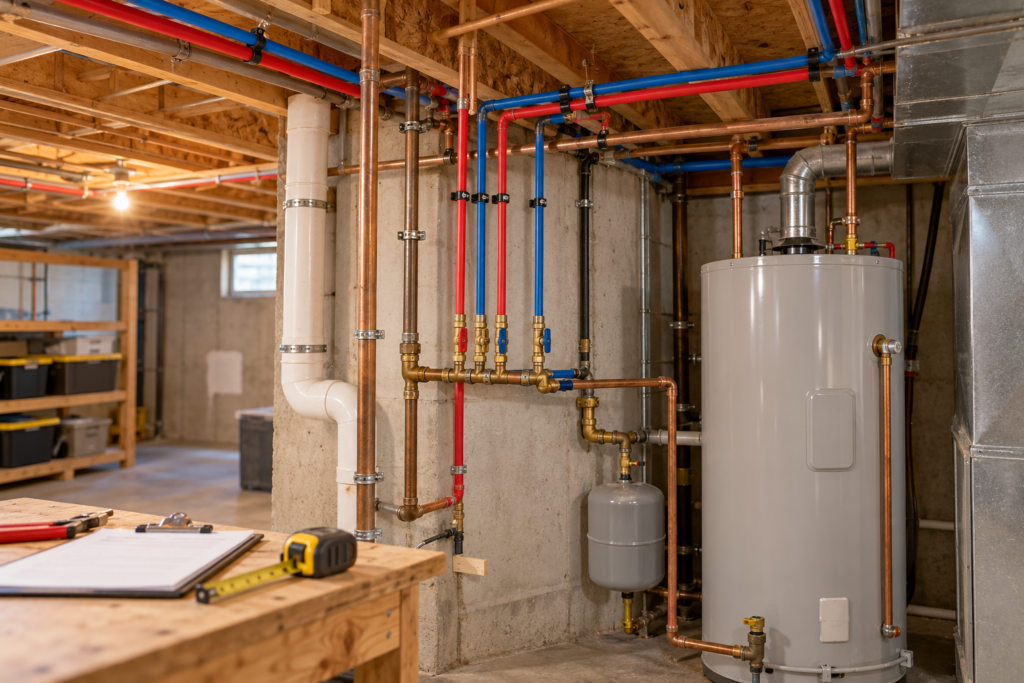
A whole-house repipe estimate should identify exactly which water-supply pipes will be replaced, where the work begins and ends, how new piping will reach each fixture, and what testing and restoration are included. A total price without those boundaries is difficult to compare with another proposal.
Two estimates can describe a whole-house repipe while covering different work. One may include hot and cold branches, fixture shutoffs, access openings and patching; another may cover only the main distribution runs. The better decision starts with a written scope tied to your home’s actual piping.
Before approving work in an Indianapolis home, ask the plumber to separate confirmed findings from assumptions about concealed lines. Age or one leak alone does not establish that every supply pipe needs replacement. A proposal should explain why its recommended scope fits the condition found.
Define Which Pipes the Estimate Covers
Water-supply piping carries pressurized water to faucets, toilets, appliances and the water heater. Drain, waste and vent piping serves a different function. Replacing supply pipes does not automatically replace bathroom drains, a sewer lateral, gas piping or the underground water service line.
Ask for a description that names the starting connection and each included branch. A floor plan, marked photograph or fixture list can make the boundary clearer than a general phrase such as all plumbing. Compare these parts of the proposed scope:
- Hot and cold distribution lines inside the home, including upper floors and additions.
- Connections to sinks, showers, tubs, toilets and laundry equipment.
- The connection at the water heater and any existing recirculation loop.
- Outdoor hose bibs and branches serving an attached garage or other included space.
- Main and fixture shutoff valves, with retained valves identified.
- The underground service line, drains and other systems explicitly included or excluded.
D.W. Plumbing offers whole-home repiping in Indianapolis. An evaluation can help define the supply-line work without assuming that unrelated drain or sewer work belongs in the same project.
Ask What Supports the Recommended Scope
A useful estimate connects the proposed replacement to observed conditions: repeated leaks in separate locations, restrictions in accessible pipe, incompatible repairs, or other findings. Ask which sections were inspected and which remain concealed.
If a small accessible branch is the only confirmed problem, ask whether a limited repair or partial repipe is reasonable. If failures are widespread, ask how a larger scope changes the risk of continued repairs and repeated access openings.
Keep photographs, dates and locations of past repairs. A record showing several separate failures is more informative than a statement that the plumbing has had problems for years.
A repipe may address restrictions within old supply piping, but it cannot guarantee a pressure improvement when the cause is a utility supply condition, a partly closed valve, an undersized service line or a fixture restriction. Ask how those possibilities were evaluated.
Specify Materials and Connection Details
The proposal should identify the pipe material, applicable sizes and fitting system. Material choice depends on installation conditions, routing, water characteristics and applicable requirements; it should not be reduced to a claim that one material is best for every home.
Ask how transitions to retained piping will be made and supported. The estimate should account for accessible valves, fixture connectors and the connections at the water heater, rather than leaving every termination as a later extra.
Understand the Access Plan Before Work Starts
Pipe routes through a basement or accessible crawlspace create different access needs from routes inside finished walls or above a tiled shower. Walk through the proposed openings with the plumber before approving the work.
Ask which walls, ceilings, cabinets or floors are likely to be opened and which findings could change that plan. Protecting finished rooms and moving belongings should have a named responsibility so preparation does not become a surprise on the first day.
Separate Plumbing From Finish Restoration
An estimate should state whether it includes closing access openings, drywall finishing, texture matching, paint, tile or cabinet repairs. These are different tasks, and included patching may not mean a room will be completely repainted.
Ask who handles each restoration stage and when it can begin. Testing and any required inspection may need to occur before openings are closed. Closing walls too early can hide work that still needs review.
If a separate contractor will restore finishes, request enough detail about expected openings to obtain a comparable restoration estimate. Include that work when comparing the total disruption and project scope.
Look for Testing and Completion Requirements
The new installation should be checked using methods appropriate to its materials and applicable requirements. Ask what testing is planned, who performs it, and how leaks, pressure concerns or incomplete connections will be corrected before handover.
Permits and inspections depend on the work and jurisdiction. Ask the contractor to identify which requirements apply to your address and whether those responsibilities and fees are included. Do not assume a general proposal has already addressed them.
- The exact supply lines and fixture connections being replaced.
- Specified materials, fittings and transition points.
- The valves and accessible shutoffs included in the work.
- Access openings and protection of finished areas.
- Plumbing tests and any required inspection arrangements.
- Flushing and checks at fixtures after reconnection.
- Finish restoration responsibilities and exclusions.
- The process for documenting unexpected conditions and scope changes.
Water heater connections deserve attention during a repipe, but replacing the heater is a separate decision. If the equipment also needs evaluation, D.W. Plumbing provides water heater and tankless water heater service; ask for that work to be identified separately.
Plan for Water Interruptions and Household Access
Ask when water will be unavailable, whether any fixtures can remain usable between work stages, and how the schedule will be communicated. Do not rely on a universal completion time; routing, access and inspection needs differ between homes.
Tell the plumber about household needs that affect scheduling, including essential appliance use, accessibility needs, pets and rooms that cannot easily be emptied. Discuss these before a crew arrives so the work sequence can account for them.
Keep the main shutoff reachable and ask which fixtures may be used during each stage. Do not operate valves, reconnect appliances or restore water to isolated work unless the contractor has said it is safe.
Compare Scope Changes Before Comparing Totals
A concealed condition can change the work after access is opened. The proposal should explain how additional work will be described and priced, and how you will approve it before it proceeds.
- Which rooms or branches were directly inspected.
- Where existing pipe will remain connected to new material.
- Any known inaccessible runs or unusual access limitations.
- Past leak locations and repairs that influenced the recommendation.
- Any separate service-line, drain or water-heater work being considered.
- Your expectations for drywall, paint, tile and cabinet restoration.
- Household needs during water interruptions.
- Who will provide completion records and answer follow-up questions.
Ask for a revised written scope if the proposal changes substantially. Comparing a partial repipe with a more complete supply replacement by price alone can hide important differences in what the home will receive.
Get a Repipe Scope You Can Evaluate
If you are comparing repiping proposals for an Indianapolis home, D.W. Plumbing can assess the existing supply piping and discuss a defined scope. Call (317) 500-1009 to arrange an evaluation and ask which connections, access work, testing and restoration belong in the estimate.
Keep the final proposal and any approved changes with photographs and completion records. That record makes future maintenance easier and gives you a clear account of which old pipes remain.
Common Questions About Repipe Estimates
Does a whole-house repipe include the sewer line?
Usually the term refers to water-supply piping, but the contract controls the actual scope. Drains, vents and the sewer lateral should be listed separately if included. Ask for an explicit exclusion when those systems are staying in place.
Will the underground water service line be replaced?
That line may be outside the interior repipe scope. Ask where the work begins and whether the line from the utility connection or meter to the house is included, retained or recommended for separate evaluation.
Should every shutoff valve be replaced?
Ask the plumber to identify which valves are included and why any existing valves will remain. Condition, accessibility and the final connection plan matter more than an assumption that every estimate handles valves the same way.
Is drywall patching the same as repainting?
No. Closing an opening, finishing drywall, matching texture and painting are distinct tasks. The proposal should state which are included, who completes them and what finish matching can reasonably achieve.
Can I stay in the house during the repipe?
That depends on access, usable fixtures and the water interruption plan. Ask for the likely sequence and any periods when the home will lack usable water or sanitation, then plan around your household’s needs.